There are two approaches that you can take to present the results in the standard time format (hours : minutes : seconds). You use the subtraction operator (-) to find the difference between times, and then do either of the following:
In this article, we will explore the various methods to calculate the time difference in Excel, including basic subtraction, TEXT, and MOD functions with specific formulas.
To calculate the difference between two times in hours in Excel, you can use a formula that subtracts the start time from the end time, adding conditional logic as needed to handle cases where start and end times cross midnight.
Learn how to calculate the TimeDifference in Excel with easy formulas. Step-by-step guide for accurate time tracking. Calculating the TimeDifference in Excel is a common requirement for tracking work hours, managing schedules, or analyzing time-based data.
Discover how to calculate the difference between two times in Excel, using formulas to measure time intervals for scheduling, time tracking, or analysis.
The Basics: Understanding Excel’s Time Format Excel treats time as a fractional part of a 24-hour day. This is crucial to understanding how to find the timedifference in Excel. For example:
Since time is stored as a number in Excel, find the difference between 2 time values, you can easily subtract the start time from the end time. The result of the subtraction would also be a decimal value that would represent the time that has elapsed between the two time-values.
We’ll show you a few ways to find the difference between two times in Excel for project tracking, a work timesheet, or an employee schedule. To correctly use the functions and formulas described here, be sure to use one of Excel’s time formats for the time values in your cells.
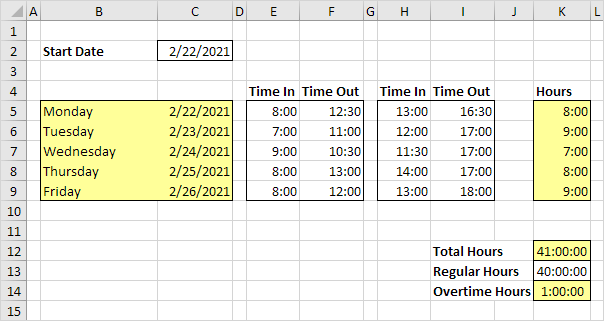 Calculating the difference between two times in Excel can be tricky. Times are handled internally as numbers between 0 and 1.